It reaches me before I see anything.
That dark, garlicky pull of soy and braising liquid, drifting low across the tables at Maxwell. I haven’t even sat down yet. My camera’s still in the bag, lens cap on, and already the morning has decided what it wants me to notice.
I follow the smell the way you follow a sound in the dark. Slowly. Not sure where it ends.
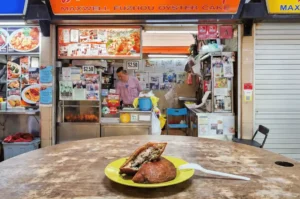
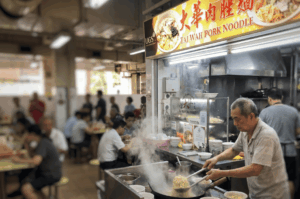
It leads me toward the duck. Some sauces announce a stall before any signboard does. The braise here is thick and slow, the kind that has been topped up and never fully emptied, building flavour over years the way a river carves stone. The uncle ladles it over rice without looking. He’s done this ten thousand times. His wrist knows the measure better than his eyes do.
I stand to the side and wait.
The light at this hour falls in narrow bars through the upper vents. It lands on the stainless counter, then slides off as someone moves a tray. You don’t chase that light. You wait for it to come back. So I do. I watch the steam lift off a fresh plate, catch the bar of light for half a second, and lose it again before I lift the camera.
I take the shot anyway. One frame. The braise glistening, the rice underneath going dark at the edges where the sauce has pooled.
I don’t take a second. There’s a queue forming, and a man behind me holding coins in his palm, ready. This isn’t my kitchen to slow down.
A few stalls down, the air changes.
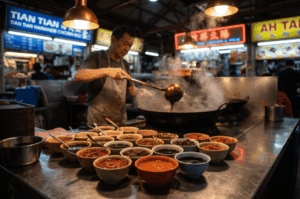
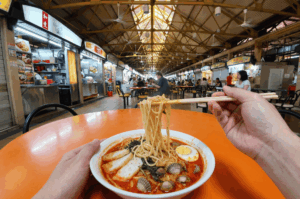
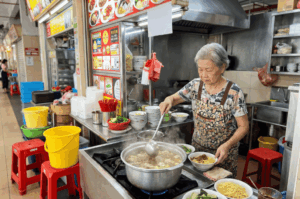
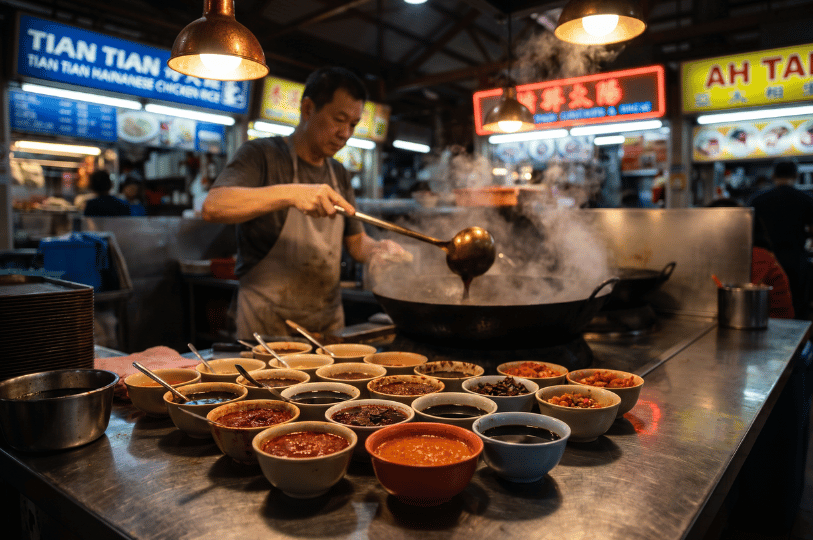
Now it’s coconut and chilli, sweeter, rounder. Different sauce, different language. The auntie at the laksa stall stirs her pot with a long spoon, the motion small and constant, like she’s keeping time for the whole row. She doesn’t talk much. She doesn’t need to. The sambal does the talking, sitting red and patient at the corner of her station.
I think about how every stall here is really built around one liquid.
The braise. The broth. The sauce spooned at the last second. The food is the noun, but the sauce is the verb. It’s the part that moves, that carries memory, that someone’s grandmother probably argued about decades ago. You can copy a recipe. You can’t quite copy a wrist that’s been doing this since before you were born.
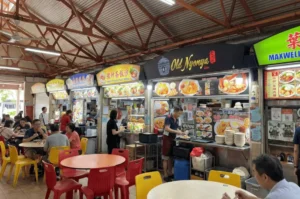
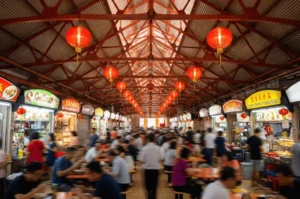
I find a seat at a shared table. A fan clacks somewhere overhead, loose on its mount. Across from me, a regular eats his duck rice in silence, newspaper folded into a small square so it fits beside his plate. He’s not in a hurry. None of the morning people are. The hurry comes later, with the office crowd.
My plate arrives and I eat before I photograph. This is a habit I’ve kept on purpose.
The duck is tender, the sauce salt-sweet and deep, with that faint bitterness at the back that tells you it’s the real thing and not a shortcut. I taste it and I’m somewhere else for a moment, a smaller table, a younger me, an adult’s hand pushing a bowl toward me without a word.
Some smells don’t just season the food. They unlock the years.
I wipe my hands and pick the camera back up. The light has shifted again. The uncle is still ladling, still not looking, still keeping the braise alive for whoever comes next.
I don’t take another photo.
Some things you keep on a card. Some you just keep.
And the sauce, the one that started all this before I’d even sat down, is already cooling on my plate, going quietly back to being ordinary.
I let it.

To the Smell of the Sauce That Defines the Dish
July 17, 2026
It reaches me before I see anything. That dark, garlicky pull of soy and braising liquid, drifting low across the tables at Maxwell. I haven’t even sat down yet. My camera’s still in the bag,…
-
Best Stalls at Newton Food Centre: A Photographer’s Honest Guide
July 16, 2026
I’ve been coming to Newton Food Centre for years, usually with a camera slung over one shoulder and no real plan for dinner. It sits at 500 Clemenceau Avenue North, a three-minute walk from Newton…
-
A Letter to Stories That Unfold With Every Bite
July 14, 2026
Morning light slants across the stainless steel table, starting as a narrow beam before slowly spreading out. I’m sitting in the corner of Maxwell Food Centre, my camera still tucked away. I like to watch…
-
Old Nyonya at Maxwell Food Centre: A Quieter Bowl Among the Noise
July 13, 2026
I didn’t go to Maxwell Food Centre for Old Nyonya. Almost nobody does. You go for the chicken rice. You go for the queue that bends around the corner, the one everyone photographs. But that…
-
To the Sound of the First Chopsticks Clinking
July 10, 2026
The first pair lifts before the bowl has even cooled, and the sound finds me before I see it. It is early, just before eight at Maxwell Food Centre, and the porridge stall has opened…
-
Maxwell Fuzhou Oyster Cake at Maxwell Food Centre: A Golden and Crispy Frame
July 9, 2026
I didn’t set out to eat an oyster cake that day. I’d originally planned to grab chicken rice, specifically the famous Hainanese chicken rice, but after wandering around Maxwell Food Centre and exploring the many…
-
A Quiet Thank You to the Stirring Hands in the Back Alley
July 7, 2026
The pot has been going for hours, and the woman stirring it does not look tired. It is late afternoon behind a row of shophouses near Old Airport Road, in the narrow lane where the…
-
Tian Tian Hainanese Chicken Rice: A Review of Maxwell’s Most Photographed Plate
July 6, 2026
The long queue moves in inches. Plates leave the counter fast. Chicken lands. Rice follows. Chilli sauce, black soy sauce, and ginger sit beside the plate. The next order is already being called. Tian Tian…
-
To the Forgotten Recipes, Guarded in the Heart of the Stall
July 3, 2026
The old man measures by hand, and I never see him weigh a thing. It is mid-morning at Hong Lim Market, and the bak chor mee stall has slowed for a breath between the breakfast…
-
A Photographer’s Guide to Maxwell Food Centre: Frame Shots, Timing, and Table Scenes
July 2, 2026
My first visit to Maxwell Food Centre left me with dozens of uninspiring photos, grey chicken rice, missed steam, and annoyed diners. It took time to learn that Maxwell Food Centre Singapore doesn’t pose for…