The knife lands softly before it cuts.
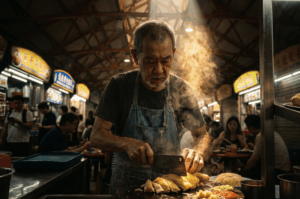
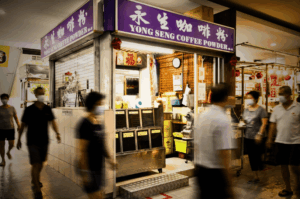
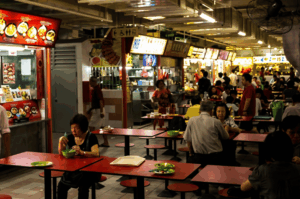
I hear it before I lift the camera. A low wooden sound, not sharp, not rushed. At Maxwell Food Centre, the lunch crowd is already pressing into the aisles, but behind the glass at Ah Tai Hainanese Chicken Rice, the man at the board moves as if the noise belongs to another room.
His left hand steadies the chicken. His right hand holds the cleaver close to the blade, fingers relaxed, wrist loose. The metal catches the white stall light for a second, then disappears into the pale skin and tender flesh. One cut. A pause. Another cut. The pieces fall into place with quiet weight.
I stand slightly to the side, careful not to block the queue. My camera rests against my chest. Through the viewfinder, the world narrows to his hands, the chopping board, the steam rising from rice, the small pool of soy sauce darkening at the edge of a plate. Everything important seems to happen below eye level.
The uncle does not look up often. He does not need to. His body knows the distance between the bird and the plate, the plate and the counter, the counter and the waiting hand. There is no performance in it. Only repetition, clean and exact.
I press the shutter once when the cleaver lifts.
The frame is almost right, but not quite. The blade is bright. The hand is steady. The chicken is blurred where it falls. Still, something is missing. Maybe it is the small breath before the cut. Maybe it is the way the queue quiets for half a second when food is being portioned. Maybe it is the patience held inside a gesture that has been repeated for years.
The knife keeps moving.
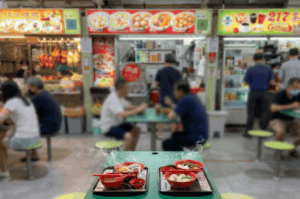
Around him, the hawker centre carries on. Trays slide across tables. A child pulls at a plastic chair. Someone tears open a packet of chili. Sunlight enters through the high openings and breaks into strips across the tiled floor. It touches the metal counter, then the glass, then the edge of my lens.
I think about how many meals begin this way, not with hunger, but with a hand choosing where to cut. A good knife does not hurry because it already understands time. It follows the grain, the joint, the memory of every order before this one.
When my plate arrives, I do not photograph it immediately.
I watch the steam lift from the rice. I notice the uneven slices, the shine of sesame oil, the cucumber pressed quietly to one side. The cleaver continues behind the glass, steady as a clock no one needs to wind.
Some photographs are made by waiting for motion.
Others are made by learning not to disturb it.

A Note to the Knife That Cuts, But Never Hurries
June 9, 2026
The knife lands softly before it cuts. I hear it before I lift the camera. A low wooden sound, not sharp, not rushed. At Maxwell Food Centre, the lunch crowd is already pressing into the…
-
Wang BBQ Chicken Wing & Satay: Photographing Smoke, Wings, and Skewers at Chomp Chomp Food Centre
June 8, 2026
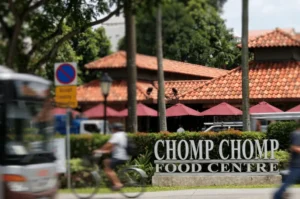
I reached Chomp Chomp Food Centre at 20 Kensington Park Road, Serangoon Gardens, Singapore on a Tuesday evening around 7pm, just as the place was beginning to thicken with supper energy. The tables were filling…
-
To the Fragrance That Lingers Long After the Meal
June 5, 2026
The evening air at Old Airport Road Food Centre is thick and warm. It wraps around me the moment I step away from the open street. I walk past the bright neon signboards, letting the…
-
Lau Pa Sat Satay Street: Photographing After-Work Satay in Singapore’s CBD.
June 4, 2026
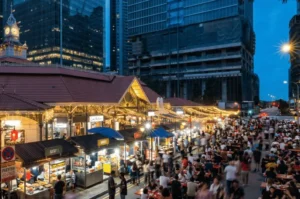
I visited Lau Pa Sat Satay Street on a Tuesday around 7pm, just as Boon Tat Street was changing its identity from a busy traffic route in Singapore’s CBD to a lively alfresco dining venue….
-
A Letter to the Hidden Moments Between the Shots
June 2, 2026
The afternoon heat settles heavily over Tiong Bahru Market. The frantic noise of the lunch hour is completely gone. I sit at a corner table near the open balcony. The green tiles reflect the warm,…
-
Izakaya Singapore: More Than Just After-Work Spots
June 1, 2026
When we talk about izakayas in Singapore, we often reduce them to simple after work drinks spots. We picture loud rooms where tired professionals go to drink cold beer and eat cheap bar snacks. But…
-
The Quiet Moments Before the First Order
May 29, 2026
The sky outside is still a deep, bruised purple. Inside the food centre at Toa Payoh Lorong 8, the air is cool and heavy with the scent of damp concrete and raw ginger. I sit…
-
Flame, Smoke, and Sizzle: The Art of Grilling in Singapore’s Izakayas
May 28, 2026
A chef stands behind a trough of white-hot binchotan charcoal. He holds a fan in one hand and carefully turns a row of wooden chicken skewers with the other. He does not rush. He waits…
-
To the Vendors Who Know No Rest, Yet Keep Going
May 26, 2026
The air at Chinatown Complex Food Centre always carries a thin layer of grey soot by the time the evening arrives. I stand near the edge of the green tiled floor. The noise of the…
-
The Heart of the Grill: The Master Craftsmen Behind Izakayas Singapore Prides On
May 25, 2026
When I first started photographing food in Singapore, I had a very narrow view of what Japanese dining looked like. I walked right past the smoky, loud, narrow storefronts of local izakayas. I thought they…