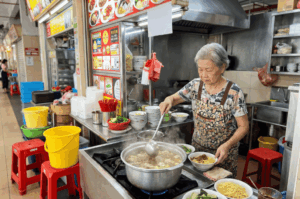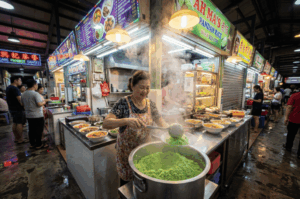
The pot has been going for hours, and the woman stirring it does not look tired.
It is late afternoon behind a row of shophouses near Old Airport Road, in the narrow lane where the kitchens spill out their back doors. She stands over a wide pot of lor mee gravy, dark and thick, stirring with a long wooden ladle. The motion is slow and even, a circle she has drawn ten thousand times. The gravy thickens because she does not let it forget her.
I am standing at the mouth of the alley, camera against my chest, not yet ready to lift it. There is something here I want to understand before I photograph it.
The light is soft at this hour, falling sideways between the buildings, landing on the steam that lifts off the pot. Behind her, crates are stacked against the wall. A fan turns on a shelf, pushing warm air around. This is not the front of the stall, where the customers sit. This is the back, where the work that no one watches gets done.
I lift the camera and frame her hands on the ladle.
She does not notice me, or chooses not to. Her eyes stay on the gravy, reading it the way you read a face. She tilts the ladle, watches how the gravy falls from it, and stirs again. The thickness has to be right. Too thin and it slides off the noodles. Too thick and it forgets how to coat them. Only her wrist knows the difference.
I think about how much of the food we love begins here, in the back, in the hours before the queue forms. The stocks set to simmer before dawn. The chilli ground while the city still sleeps. By the time we sit down out front, the hard part is already finished, hidden behind the counter and the steam.
A man at the next kitchen scoops kway chap broth into a metal tub, the herbal smell drifting over. He works without hurry too, his shoulders loose, his hands sure. Neither of them performs. There is no audience back here, only the pot and the ladle and the long afternoon.
I press the shutter on her hands, then again as the steam catches the light.
The image will not hold the smell, or the warmth of the lane, or the patience folded into each turn of the ladle. But I keep it, because so much of this work goes unthanked. We praise the bowl when it reaches us. We rarely think of the stirring that made it.
A thank you does not always need to be heard to be meant.
She taps the ladle once against the rim, sets it down, and wipes her hands on her apron. The gravy is ready. Out front, someone will order a bowl in a few minutes and never know how long she stood here, drawing the same slow circle.
I lower the camera and step back, leaving the alley to its quiet.
Some hands you photograph. Some you simply thank, silently, on your way past.

A Quiet Thank You to the Stirring Hands in the Back Alley
July 7, 2026
The pot has been going for hours, and the woman stirring it does not look tired. It is late afternoon behind a row of shophouses near Old Airport Road, in the narrow lane where the…
-
Tian Tian Hainanese Chicken Rice: A Review of Maxwell’s Most Photographed Plate
July 6, 2026
The long queue moves in inches. Plates leave the counter fast. Chicken lands. Rice follows. Chilli sauce, black soy sauce, and ginger sit beside the plate. The next order is already being called. Tian Tian…
-
To the Forgotten Recipes, Guarded in the Heart of the Stall
July 3, 2026
The old man measures by hand, and I never see him weigh a thing. It is mid-morning at Hong Lim Market, and the bak chor mee stall has slowed for a breath between the breakfast…
-
A Photographer’s Guide to Maxwell Food Centre: Frame Shots, Timing, and Table Scenes
July 2, 2026
My first visit to Maxwell Food Centre left me with dozens of uninspiring photos, grey chicken rice, missed steam, and annoyed diners. It took time to learn that Maxwell Food Centre Singapore doesn’t pose for…
-
A Note on the Flicker of the Flame That Feels Like Home
June 30, 2026
The wok catches first, and then the whole stall seems to breathe. It is just past six at Tiong Bahru Market, second floor, and the char kway teow uncle has tilted his wok toward the…
-
The Stalls That Hold Maxwell Food Centre Together
June 29, 2026
I have been coming to Maxwell Food Centre for years now, at all the wrong and right hours. Early mornings when the porridge stalls are stirring and the room still smells of bleach and steam….
-
To the Light That Filters Through the Smoke
June 26, 2026
The smoke rises first, and then the light finds it. It is late afternoon at Adam Road Food Centre, and the satay stall has just lit its coals. The skewers are not on the grill…
-
On a Stick: Singapore Skewers for Grilled Meat Foodies
June 25, 2026
The first thing I learned about Singapore’s street food life wasn’t a flavor. It was the smoke. Years ago, at a satay stall in Lau Pa Sat, I noticed the seller wasn’t watching the meat….
-
A Moment of Silence for the Rice, Steaming Gently
June 23, 2026
The lid lifts, and the steam rises before the smell does. It is just past noon at Chinatown Complex Food Centre, and the queue at the chicken rice stall has thinned for a moment. The…
-
Isle Cafe at Cuppage Plaza: Local Flavors with Old School Charm
June 22, 2026
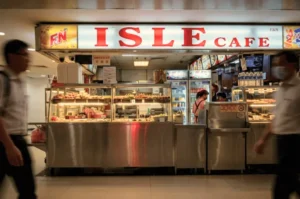
I usually come to Cuppage Plaza for the smoke and the izakaya counters, but this time I was here for something far simpler. A plate of cai png, eaten fast, in the middle of a…