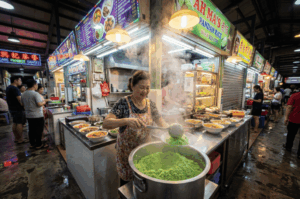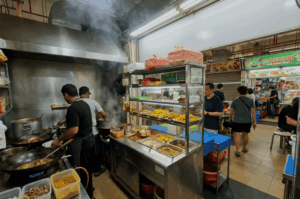
The wok catches first, and then the whole stall seems to breathe.
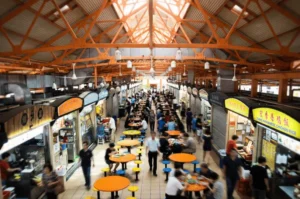
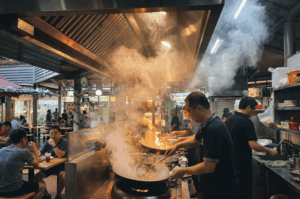
It is just past six at Tiong Bahru Market, second floor, and the char kway teow uncle has tilted his wok toward the burner. A line of orange leaps up the side, fast and low, then drops back down. He does this without looking. His face is already turned toward the next order.
I am standing a few steps back, camera resting against my chest, watching the flame more than the man. There is something in the way it rises that I keep coming back to. Not the heat of it. The familiarity.
The flame is the same color it has always been. The same color it was when my father took me to a stall like this one, before I knew anything about light or framing or the patience it takes to wait for a moment to arrive. I did not know then that I was learning to look. I only knew that the fire meant food was coming, and that we would sit and eat without saying much.
I lift the camera and wait for the next lift of flame.
It is harder than it sounds. The fire comes when the wok is moved, and the wok moves on his rhythm, not mine. I press the shutter a beat too late on the first try. The orange has already collapsed into smoke. Some things will not wait for you to be ready.
He shakes the wok again, and the noodles fold over themselves, dark and glossy, catching the burner light. The flame jumps. This time I have it, or close to it. The fire framed against the black of the pan, his wrist a soft blur at the edge.
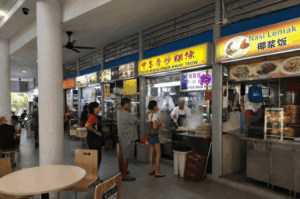
Two stalls down, an auntie ladles laksa into bowls, the steam rising thin into the warm air. She does not use fire the way he does. Hers is a quieter heat, held in the broth, kept low and steady. But it is the same continuity, the same hands repeating the same small motions until they have worn themselves smooth.
I think about how a flame holds memory better than a photograph.
The image I take tonight will fade in a folder somewhere. But the flicker itself, that exact orange against the dark, has not changed in all the years I have been watching it. It was here before my camera. It will be here after.
The uncle plates the kway teow, slides it across the counter, and wipes his hands on the cloth at his waist. The burner settles to a low blue hum, waiting for the next order, the next lift, the next flame.
I lower the camera and order a plate.
I eat it near the burner, where the warmth still reaches, and let the fire keep its quiet rhythm beside me. Some things you photograph to keep. Some things you keep simply by sitting close to them, while they still burn.

A Note on the Flicker of the Flame That Feels Like Home
June 29, 2026
The wok catches first, and then the whole stall seems to breathe. It is just past six at Tiong Bahru Market, second floor, and the char kway teow uncle has tilted his wok toward the…
-
The Stalls That Hold Maxwell Food Centre Together
June 29, 2026
I have been coming to Maxwell Food Centre for years now, at all the wrong and right hours. Early mornings when the porridge stalls are stirring and the room still smells of bleach and steam….
-
To the Light That Filters Through the Smoke
June 26, 2026
The smoke rises first, and then the light finds it. It is late afternoon at Adam Road Food Centre, and the satay stall has just lit its coals. The skewers are not on the grill…
-
On a Stick: Singapore Skewers for Grilled Meat Foodies
June 25, 2026
The first thing I learned about Singapore’s street food life wasn’t a flavor. It was the smoke. Years ago, at a satay stall in Lau Pa Sat, I noticed the seller wasn’t watching the meat….
-
A Moment of Silence for the Rice, Steaming Gently
June 23, 2026
The lid lifts, and the steam rises before the smell does. It is just past noon at Chinatown Complex Food Centre, and the queue at the chicken rice stall has thinned for a moment. The…
-
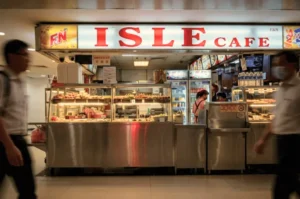
Isle Cafe at Cuppage Plaza: Local Flavors with Old School Charm
June 22, 2026
I usually come to Cuppage Plaza for the smoke and the izakaya counters, but this time I was here for something far simpler. A plate of cai png, eaten fast, in the middle of a…
-
To the Memory of the Dishes That Never Return
June 19, 2026
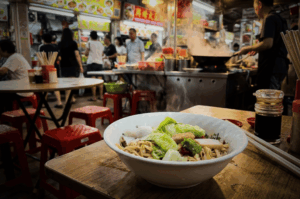
The stall is empty when I arrive. It is a corner unit at Tiong Bahru Market, second floor, where I came to photograph a plate I had been thinking about for weeks. A dry mee…
-
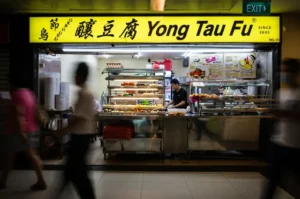
Savoring Orchard Yong Tau Fu: Cheap and Cheerful in Cuppage Plaza
June 18, 2026
I’d walked past this stall maybe a dozen times before I finally stopped. Cuppage Plaza isn’t the kind of place you go to be impressed, and that’s exactly why I keep coming back to it…
-
A Letter to the Faces Behind the Counter
June 16, 2026
You are turning over chicken wings when I first notice you. It is just past seven at Old Airport Road Food Centre, and the ceiling fans are pushing warm air down onto the tables. The…
-
How to Photograph Cuppage Plaza Food Without Disturbing the Room
June 15, 2026
The camera flash went off by mistake. It was a small, clumsy decision, but in the narrow, slightly smoky space of Kazu Sumiyaki, it felt much larger than it was. A few heads turned. The…