The old man measures by hand, and I never see him weigh a thing.
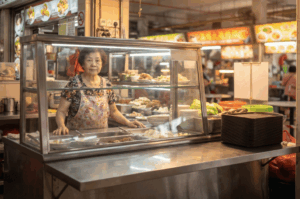
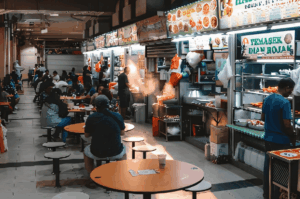
It is mid-morning at Hong Lim Market, and the bak chor mee stall has slowed for a breath between the breakfast and lunch crowds. He reaches into a tin without looking, takes a pinch of something dark, and lets it fall into the bowl. His fingers know the amount. There is no recipe written down anywhere I can see.
I stand to the side, camera lowered, watching the way his hand returns to the same tins in the same order. Vinegar, then the chilli, then a small spoon of pork lard that catches the light for a second before it melts. He has done this so many times that the motion has left his thinking and gone somewhere deeper, into the wrist, into memory.
I lift the camera and frame his hands against the dark of the counter.
I think about how much of this is kept nowhere but inside him. The exact balance of sour and savory. The moment the noodles are ready, judged by sound more than sight. A recipe like this does not live on paper. It lives in a body, and bodies do not last.
I have met hawkers who tell me their children will not take over. The hours are long, the work is hot, and the young have other lives waiting for them. I never argue. It is not my place. But I notice how the recipe sits there between us, unspoken, like a thing already half gone.
Two stalls down, an auntie stirs a pot of her own. Tau suan, thick and pale gold, the sweet soup she has sold for longer than I have been holding a camera. She tastes it from a small spoon, adds a little more sugar, tastes again. The adjustment is tiny. Only she would know it was needed.
I press the shutter on the old man’s hands, then again as he tosses the noodles in the bowl.
These images will not hold the taste. That is the part I cannot photograph, no matter how close I stand. The flavor lives in the doing, in the pinch and the pour and the timing, and the doing ends when the hands stop.
So I photograph the hands instead. The tins, worn smooth at the rims. The spoon resting against the pot. The small private gestures that carry everything the menu does not say.
Some inheritance has no will, no signature, only a pair of hands repeating themselves until they cannot anymore.
He slides the bowl across the counter. A regular takes it without a word, the way you take something from family. The old man wipes his hands and turns back to the tins, already reaching for the next order, the next pinch, the next quiet act of remembering.
I order a bowl and sit close.
I eat slowly, tasting for the things I will never be able to keep, and let the recipe stay where it belongs, guarded in the heart of the stall, for as long as the hands hold out.

The Quiet Moments Before the First Order
May 29, 2026
The sky outside is still a deep, bruised purple. Inside the food centre at Toa Payoh Lorong 8, the air is cool and heavy with the scent of damp concrete and raw ginger. I sit…
-
Flame, Smoke, and Sizzle: The Art of Grilling in Singapore’s Izakayas
May 28, 2026
A chef stands behind a trough of white-hot binchotan charcoal. He holds a fan in one hand and carefully turns a row of wooden chicken skewers with the other. He does not rush. He waits…
-
To the Vendors Who Know No Rest, Yet Keep Going
May 26, 2026
The air at Chinatown Complex Food Centre always carries a thin layer of grey soot by the time the evening arrives. I stand near the edge of the green tiled floor. The noise of the…
-
The Heart of the Grill: The Master Craftsmen Behind Izakayas Singapore Prides On
May 25, 2026
When I first started photographing food in Singapore, I had a very narrow view of what Japanese dining looked like. I walked right past the smoky, loud, narrow storefronts of local izakayas. I thought they…
-
A Quiet Reflection from the Corner of the Hawker Centre
May 22, 2026
The red plastic chair scrapes against the tiled floor. I set my camera bag on the empty seat next to me. The afternoon heat at Old Airport Road Food Centre is thick. A slow ceiling…
-
Capturing the Essence of Izakayas: How Izakaya Photography Brings These Hidden Gems to Life
May 21, 2026
I clearly remember my first time bringing a professional camera into Shukuu Izakaya & Sake Bar on Stanley Street. I walked in with a rigid plan to photograph their famous mentaiko rosti. I spent a…
-
To the Light That Only Appears at 5AM
May 19, 2026
The wet market floor at Tekka Centre reflects the deep blue of the pre-dawn sky. It is exactly five in the morning. The main overhead lights are still off. A heavy, damp quiet hangs in…
-
Where Night Settles Into the Grill: Shooting The Best Izakayas in Singapore
May 18, 2026
I have spent the last three years carrying my camera through the smoky, cramped corridors of the acclaimed “best izakaya” Singapore has. I’ve tried all of these spots, spending countless nights waiting for the perfect…
-
A Note to the Streets That Have Yet to Wake Up
May 15, 2026
The asphalt is slick with leftover midnight rain. It is 4:30 AM on Balestier Road. The city is completely silent, wrapped in a heavy, humid darkness. I stand on the corner across from Sing Hon…
-
Days Without Meat: A Study of Habit Inside Fortune Centre’s Vegetarian Culture
May 14, 2026
Let me tell you about the first time I walked into Fortune Centre with my camera. I expected a standard Singaporean food court experience: loud, chaotic, and heavily focused on the usual meat-heavy local dishes….