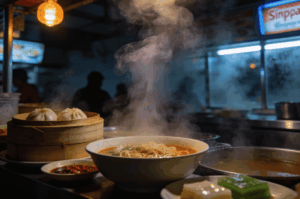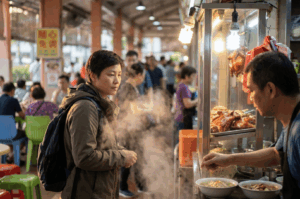
The morning air at Jalan Berseh is still cool, but the heat radiating from the charcoal fire is immediate. I stand a few steps back from the counter of Sungei Road Laksa. I watch the man tending to the broth. He does not stop moving. His right hand scoops the thin, pale orange liquid. His left hand holds a small porcelain bowl. He pours the hot broth over the thick rice noodles, drains it, and pours it again. It is a rhythm born of pure repetition.
I raise my camera. I set the shutter speed to 1/200th of a second. I want to freeze the exact moment the broth leaves the ladle, capturing the heavy droplets before they sink back into the pot. Through the lens, I focus entirely on his hands. They are worn, dusted with humidity and heat, moving with an inherited muscle memory. The light from the glowing charcoal casts a warm, flickering shadow against the tiled wall.
The man cooking is not the one who invented this bowl. The original maker has passed on. Yet, the food remains exactly the same. We often think of recipes as written words on a piece of paper, hidden away in a kitchen drawer. But a true street food recipe does not exist on paper. It exists entirely in the body. It is passed down through the angle of a wrist, the pinch of sambal, the precise judgment of a charcoal flame.
I lower the camera and step forward to order a bowl. The gravy is light, fragrant with dried shrimp and coconut milk. The cockles are barely cooked, just warmed by the residual heat of the broth. I eat quietly at a small metal table near the back of the coffee shop. As I watch the morning crowd gather, I realize that cooking a heritage dish is a quiet form of resurrection. Every time the fire is lit and the broth is stirred, the person who first created it is brought back. They are present in the scent of the steam and the taste of the soup.
The queue grows longer behind me. The scooping continues. The fire glows bright orange under the battered aluminum pot. The light shifts slowly across the floor as the morning wears on. Some things refuse to be forgotten. They simply change hands, resting quietly in the care of those who stay behind to stir the pot.

Holland Village: East Meets West Journey of Food and Photography
January 2, 2026
There is a corner of Singapore where the laid-back charm of a European village collides with the vibrant energy of a Southeast Asian city. It is a place where the aroma of freshly brewed espresso…
-
The Tease of Motion: Capturing Culinary Food in Photography
December 29, 2025
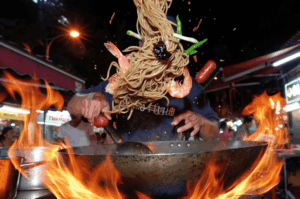
Food is rarely static. It drips, sizzles, steams, and crumbles. It is poured, flipped, chopped, and shared. Yet, so often, we see food in photography presented as a perfectly still, lifeless object on a plate….
-
Chili Crab: Singapore’s Sultry Affair Captured in Food Photography
December 26, 2025
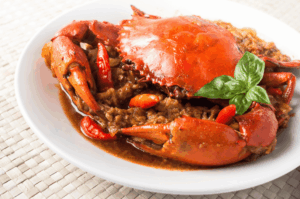
It arrives at the table not as a dish, but as an event. A magnificent Sri Lankan mud crab, resplendent in a sea of vibrant, glossy sauce the color of a tropical sunset. Steam rises…
-
Flame & Flesh: The Primal Art of Satay Through Food Photography
December 22, 2025
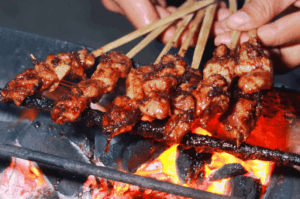
Sparks dance into the twilight sky, illuminating a face etched with concentration. The air fills with the scent of charred meat, caramelized marinade, and burning charcoal. Rows of bamboo skewers are turned rhythmically over glowing…
-
Hands of Time: A Food Photographer’s Encounter with Traditional Kaya Toast Masters
December 19, 2025
The air before dawn has a quality all its own. It is cool and hushed, thick with anticipation. On a quiet street corner in Singapore, long before the city awakens, a soft, golden light spills…
-
Steam & Seduction: Singapore for Foodies
December 15, 2025
The air in Singapore is never just air. It is a potent cocktail of sensation, a humid embrace laced with the fragrant perfume of pandan, the sharp zest of calamansi, and the deep, soulful aroma…
-
Spice Affair: Singapore Foodies’ Guide to Little India
December 12, 2025
The moment you step onto Serangoon Road, the world changes. The air grows thick with the heady perfume of jasmine garlands, sweet incense, and a complex blend of toasted spices that seems to emanate from…
-
The Morning Ritual: Street Food Hawkers Before Dawn
December 8, 2025
The world is dark, cloaked in a tranquil stillness that precedes the sunrise. A deep blue hue hangs over Singapore, and the only sounds are the distant hum of a lone vehicle or the gentle…
-
Midnight Confessions: The Secret Language of Supper in Food Images
December 5, 2025
The city exhales. Its daytime hustle recedes into a quiet hum, replaced by a different kind of pulse. On street corners bathed in the lonely glow of a single lamp post, a new world awakens….
-
Bespoke Tasting Tour: Michelin Street Food in Singapore
December 1, 2025
Imagine a culinary journey tailored just for you, a path that winds through the heart of a city’s most celebrated flavors, with every stop a new delight for both your palate and your camera lens….