By Aaron Ong For Street Food Photographer
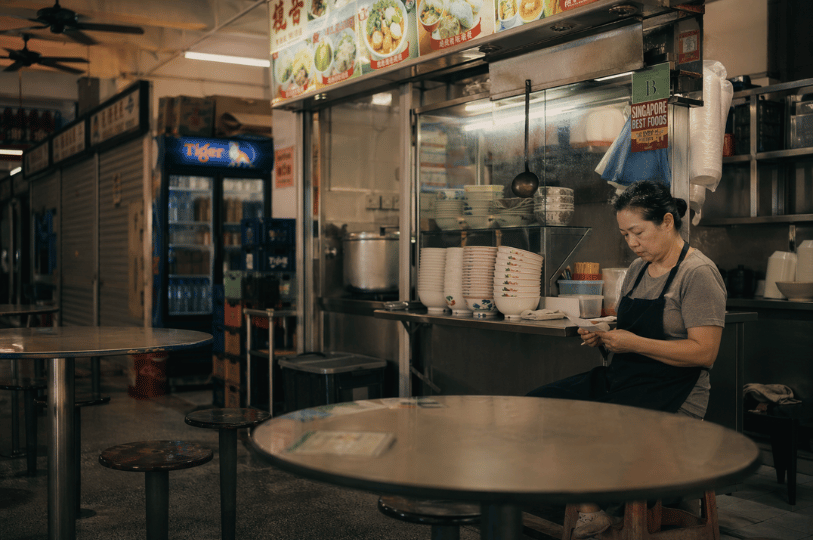
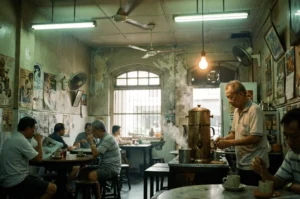
It is 3:15 PM. The ceiling fans move air that feels heavier than it looks, pushing it in slow circles across rows of empty tables. The lunch rush has already dissolved, leaving behind trays that have been cleared but not yet forgotten. A few seats down, a stainless steel noodle stall sits in quiet reset, its glass counter fogging slightly at the edges where steam had recently risen and disappeared.
I do not lift my camera yet. I sit with it resting on the table, hands loosely around the strap, watching how the light falls without interruption. The stall is not in operation, but it is not still either. A large pot of broth continues to simmer on a low flame, its surface trembling gently, releasing thin curls of steam that dissolve into fluorescent light.
Behind the counter, the cook sits on a faded plastic stool. Not cooking, not serving. Just there. A small folded paper rests in her hands. From where I sit, I trace the scene without looking through the viewfinder. The composition forms itself slowly: stacked bowls with chipped floral prints, a hanging ladle, the stainless counter reflecting a softened version of the room.
I notice how quiet becomes its own kind of structure in spaces like this. Not emptiness, but a pause that still holds form. Even the hum of the refrigerators feels positioned, placed deliberately against the silence left by the crowd.
The cook reads the paper once. Then again. Her thumb smooths the crease before she folds it and slides it beneath a stack of takeaway containers. The movement is unremarkable, but I find myself holding on to it longer than expected. There is something about the way routine absorbs interruption without breaking shape.
I still do not raise the camera.
A damp cloth moves across the counter. Stainless steel catches the overhead light for a brief moment, a soft flare that disappears as quickly as it appears. Light here is never fixed. It arrives in fragments, reflected, interrupted, reshaped by whatever surface it touches.
As a street food photographer, it is easy to wait for action. The flare of a wok, the speed of service, the rush that defines the hour when everything is loud and immediate. But I have learned that the quieter hours hold something else entirely. Not performance, but residue. Not motion, but afterimage.
A customer approaches the stall. The pause breaks without ceremony. The cook stands, folds disappear beneath her apron, and the ladle returns to hand. The broth is stirred once, then portioned with the same steady rhythm as before. The stall resumes as if it had never stopped.
This is when I finally lift the camera.
The frame is already there. Steam rising in uneven threads, the cook’s arm mid-motion, bowls stacked like markers of repetition. I do not adjust much. There is no need. The scene has already decided how it wants to be seen.
I press the shutter once.
The sound is small, but it cuts through the hum just enough for me to notice the shift. The moment continues, unaffected, as though it had expected to be interrupted and simply allowed it.
When I lower the camera, I think again about the folded paper. About what was read, and what was set aside. About how many things in a hawker centre exist in that same quiet interval, unnoticed but not unimportant.
The stall keeps moving. Steam keeps rising. And I remain seated, waiting for the next small moment that does not announce itself, but simply appears.

A First-Timer’s Guide to Food Photography in Singapore for Singapore Foodies
March 23, 2026
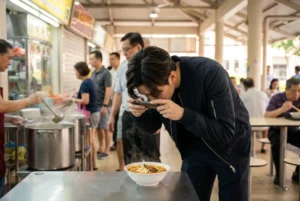
What I Wish Someone Told Me Before I Took My Phone Out When I first found myself holding a phone above steaming laksa at a hawker centre, I thought the challenge would be capturing light…

Look Here But Also There: The Singapore Foodies’ Guide to Capturing Hawker Stalls Through Visual Cues
March 20, 2026
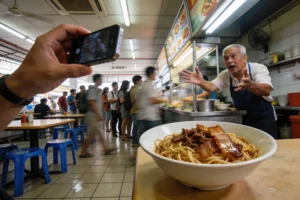
I’ll never forget the first time I tried to photograph a bowl of bak chor mee at a famous hawker stall during peak lunch hour. I was so wrapped up in capturing the perfect angle…
-
The First Hawker Stall That Changed Everything
March 18, 2026
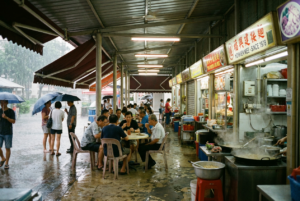
It was a rainy Tuesday afternoon about seven years ago, and I was just a guy with a camera looking for shelter. I ducked into an old, dimly lit hawker center in Toa Payoh to…

Best Breakfast in Singapore: Lighting, Angles & Visual Stories on an Early Morning
March 16, 2026
After years of chasing the perfect breakfast shot all over Singapore, I’ve noticed some venues aren’t just great for eating. They’re inspiring playgrounds for food photography, beloved by both locals and Singapore foodies alike. Whether…
-
From Empire to Plate: Process-Focused Colonial Photography SG Series
March 13, 2026
The story of Singapore cuisine is impossible to tell without acknowledging its colonial past. As a strategic port for the British Empire, Singapore became a magnet for a diverse range of people and products. From…
-
Translating Taste into Frames: Why I Capture Food
March 11, 2026
I fell in love with street food photography in Singapore, somewhere between the steam of a hawker stall and the click of my shutter. It wasn’t planned. I was hungry, wandering, half-lost, when a bowl of laksa stopped me cold. The broth glowed…
-
Maximizing Colonial Heritage: Efficient SG Photography Routes
March 9, 2026
The morning light hits the peeling plaster of a shophouse five-foot way differently than it hits a glass skyscraper. It is softer, more textured, and it seems to carry the weight of history. For a…
-
Period Restaurant Lighting in Photo Shoot in Singapore Locations
March 6, 2026
The air in a heritage Hainanese coffeeshop is thick with more than just the aroma of kaya toast and freshly brewed kopi. It is thick with a particular quality of light. A mix of harsh,…
-
Imperial Diversity Through Photo Shoot Singapore Projects
March 2, 2026
When I set up my tripod in a bustling kopitiam or a quiet heritage restaurant, I am constantly reminded that I am not just photographing a meal. I am photographing a map. Every photo shoot…
-
Historic Flavors Shoot Singapore: Post-Processing for Period Authenticity
February 27, 2026
When I look through the viewfinder at a plate of heritage kueh or a steaming bowl of rickshaw noodles, I am not just capturing food; I am framing a memory. The challenge for any documentary…