It is 3:15 PM. The ceiling fans push thick, warm air across the empty tables. The lunch rush faded hours ago, and the evening crowd has yet to arrive. I am sitting two rows away from a minced meat noodle stall, resting my hands around a glass of iced barley that has already started to sweat.
The hawker centre exists in a strange, suspended state during these mid-afternoon hours. The rhythmic chopping and shouting are gone, replaced by the low hum of refrigerators and the distant, metallic rattle of a cleaner clearing stray plates.
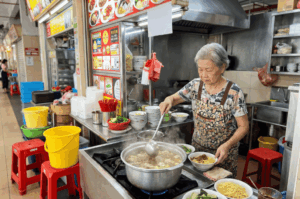
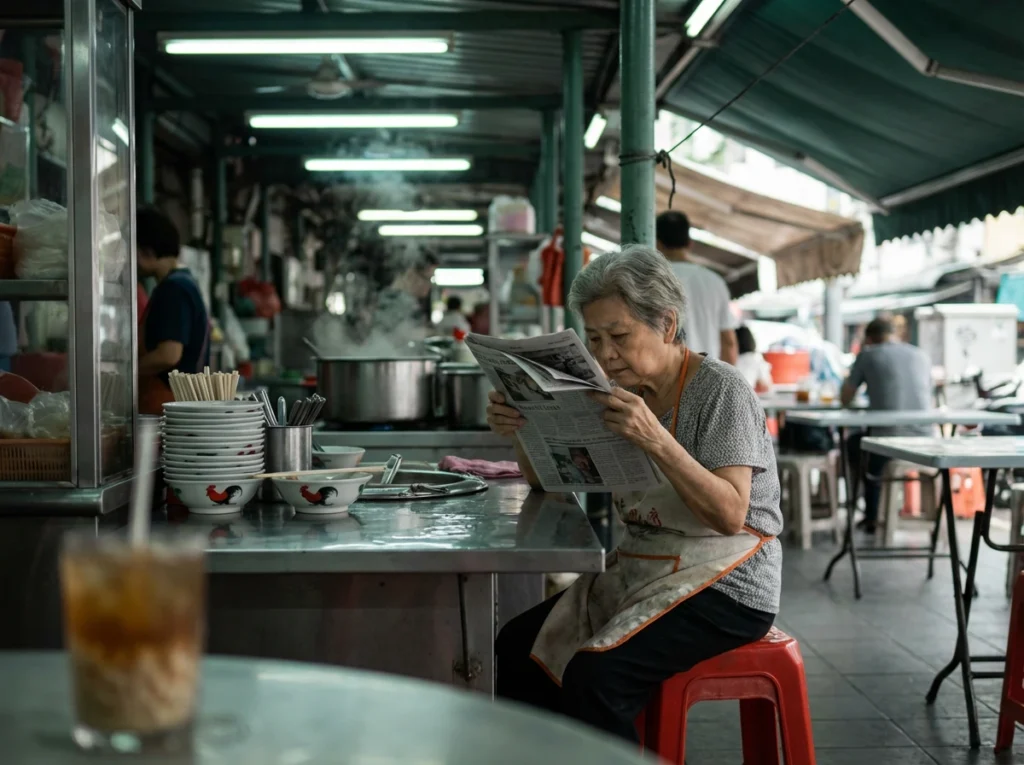
Behind the glass counter of the noodle stall, the auntie is taking her break. She is not cooking. The large steel pots of broth are still simmering on a low flame, sending thin, lazy curls of steam up into the dim fluorescent light. She sits on a faded red plastic stool in the corner of her cramped workspace, holding a small slip of paper.
I leave my camera resting on the table. I do not lift it to my eye just yet. Instead, I trace the framing of the scene from where I sit. The stacks of porcelain bowls, painted with chipped roosters, form a natural leading line straight to her. The ambient light from the overcast sky outside bleeds into the stall, casting a soft, cool shadow across her tired shoulders.
She reads the paper. She reads it twice, maybe three times. Then she folds it carefully, smoothing the crease with her thumb, and slides it out of sight beneath a stack of styrofoam takeaway boxes. She exhales—a quiet, steady release of breath—and picks up a damp cloth to wipe down the stainless steel counter. The metal catches the overhead light, gleaming for a fraction of a second before the moisture evaporates.
As a street food photographer, it is easy to fall into the habit of chasing the action. We wait for the dramatic flare of a wok, the chaotic blur of the dinner rush, or the intense focus of a cook plating a dish. We want to capture the energy of the food. But sitting here, watching the steam rise in the quiet stall, I realize these still pockets of time carry just as much weight. This is the slow exhale between the noise.
I finally lift the camera. The cold metal of the viewfinder presses against my brow. I wait for her to look up, waiting for the light to catch the side of her face through the rising vapor.
But the moment shifts. A customer steps up to the front of the stall, breaking the silence. The auntie immediately stands, leaving the folded note hidden beneath the boxes. She picks up her slotted spoon, plunging it into the boiling water. The lull is broken.
I press the shutter anyway. The image captures the blur of her arm in motion and the sudden rush of thick steam. But as I lower the camera, my mind stays on the quiet pause, the folded paper, and the unseen spaces between the bowls.

To the Smell of the Sauce That Defines the Dish
July 17, 2026
It reaches me before I see anything. That dark, garlicky pull of soy and braising liquid, drifting low across the tables at Maxwell. I haven’t even sat down yet. My camera’s still in the bag,…
-
Best Stalls at Newton Food Centre: A Photographer’s Honest Guide
July 16, 2026
I’ve been coming to Newton Food Centre for years, usually with a camera slung over one shoulder and no real plan for dinner. It sits at 500 Clemenceau Avenue North, a three-minute walk from Newton…
-
A Letter to Stories That Unfold With Every Bite
July 14, 2026
Morning light slants across the stainless steel table, starting as a narrow beam before slowly spreading out. I’m sitting in the corner of Maxwell Food Centre, my camera still tucked away. I like to watch…
-
Old Nyonya at Maxwell Food Centre: A Quieter Bowl Among the Noise
July 13, 2026
I didn’t go to Maxwell Food Centre for Old Nyonya. Almost nobody does. You go for the chicken rice. You go for the queue that bends around the corner, the one everyone photographs. But that…
-
To the Sound of the First Chopsticks Clinking
July 10, 2026
The first pair lifts before the bowl has even cooled, and the sound finds me before I see it. It is early, just before eight at Maxwell Food Centre, and the porridge stall has opened…
-
Maxwell Fuzhou Oyster Cake at Maxwell Food Centre: A Golden and Crispy Frame
July 9, 2026
I didn’t set out to eat an oyster cake that day. I’d originally planned to grab chicken rice, specifically the famous Hainanese chicken rice, but after wandering around Maxwell Food Centre and exploring the many…
-
A Quiet Thank You to the Stirring Hands in the Back Alley
July 7, 2026
The pot has been going for hours, and the woman stirring it does not look tired. It is late afternoon behind a row of shophouses near Old Airport Road, in the narrow lane where the…
-
Tian Tian Hainanese Chicken Rice: A Review of Maxwell’s Most Photographed Plate
July 6, 2026
The long queue moves in inches. Plates leave the counter fast. Chicken lands. Rice follows. Chilli sauce, black soy sauce, and ginger sit beside the plate. The next order is already being called. Tian Tian…
-
To the Forgotten Recipes, Guarded in the Heart of the Stall
July 3, 2026
The old man measures by hand, and I never see him weigh a thing. It is mid-morning at Hong Lim Market, and the bak chor mee stall has slowed for a breath between the breakfast…
-
A Photographer’s Guide to Maxwell Food Centre: Frame Shots, Timing, and Table Scenes
July 2, 2026
My first visit to Maxwell Food Centre left me with dozens of uninspiring photos, grey chicken rice, missed steam, and annoyed diners. It took time to learn that Maxwell Food Centre Singapore doesn’t pose for…