By Aaron Ong For Street Food Photographer
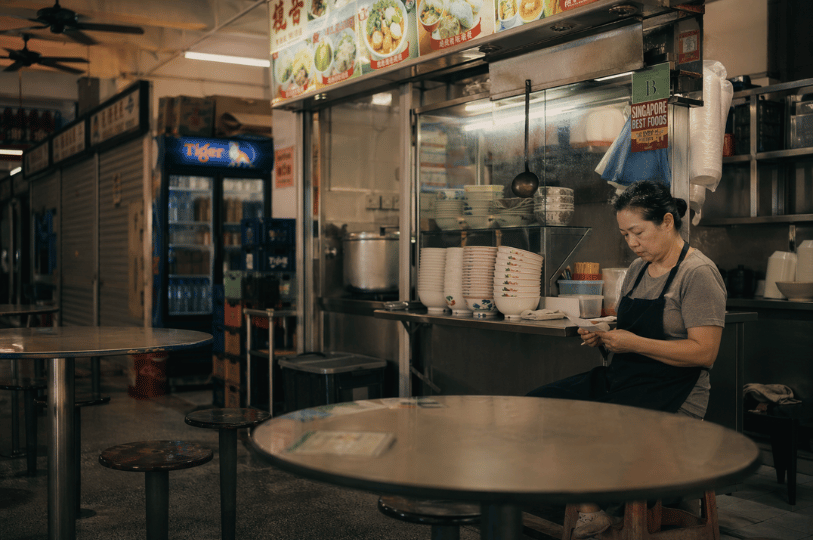
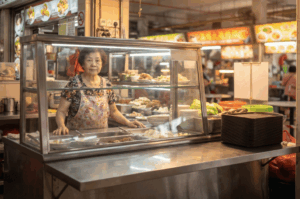
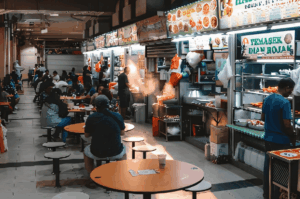
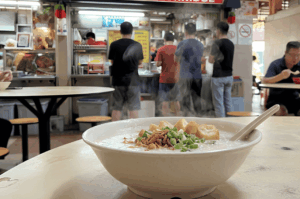
It is 3:15 PM. The ceiling fans move air that feels heavier than it looks, pushing it in slow circles across rows of empty tables. The lunch rush has already dissolved, leaving behind trays that have been cleared but not yet forgotten. A few seats down, a stainless steel noodle stall sits in quiet reset, its glass counter fogging slightly at the edges where steam had recently risen and disappeared.
I do not lift my camera yet. I sit with it resting on the table, hands loosely around the strap, watching how the light falls without interruption. The stall is not in operation, but it is not still either. A large pot of broth continues to simmer on a low flame, its surface trembling gently, releasing thin curls of steam that dissolve into fluorescent light.
Behind the counter, the cook sits on a faded plastic stool. Not cooking, not serving. Just there. A small folded paper rests in her hands. From where I sit, I trace the scene without looking through the viewfinder. The composition forms itself slowly: stacked bowls with chipped floral prints, a hanging ladle, the stainless counter reflecting a softened version of the room.
I notice how quiet becomes its own kind of structure in spaces like this. Not emptiness, but a pause that still holds form. Even the hum of the refrigerators feels positioned, placed deliberately against the silence left by the crowd.
The cook reads the paper once. Then again. Her thumb smooths the crease before she folds it and slides it beneath a stack of takeaway containers. The movement is unremarkable, but I find myself holding on to it longer than expected. There is something about the way routine absorbs interruption without breaking shape.
I still do not raise the camera.
A damp cloth moves across the counter. Stainless steel catches the overhead light for a brief moment, a soft flare that disappears as quickly as it appears. Light here is never fixed. It arrives in fragments, reflected, interrupted, reshaped by whatever surface it touches.
As a street food photographer, it is easy to wait for action. The flare of a wok, the speed of service, the rush that defines the hour when everything is loud and immediate. But I have learned that the quieter hours hold something else entirely. Not performance, but residue. Not motion, but afterimage.
A customer approaches the stall. The pause breaks without ceremony. The cook stands, folds disappear beneath her apron, and the ladle returns to hand. The broth is stirred once, then portioned with the same steady rhythm as before. The stall resumes as if it had never stopped.
This is when I finally lift the camera.
The frame is already there. Steam rising in uneven threads, the cook’s arm mid-motion, bowls stacked like markers of repetition. I do not adjust much. There is no need. The scene has already decided how it wants to be seen.
I press the shutter once.
The sound is small, but it cuts through the hum just enough for me to notice the shift. The moment continues, unaffected, as though it had expected to be interrupted and simply allowed it.
When I lower the camera, I think again about the folded paper. About what was read, and what was set aside. About how many things in a hawker centre exist in that same quiet interval, unnoticed but not unimportant.
The stall keeps moving. Steam keeps rising. And I remain seated, waiting for the next small moment that does not announce itself, but simply appears.

The Heart of the Grill: The Master Craftsmen Behind Izakayas Singapore Prides On
May 25, 2026
When I first started photographing food in Singapore, I had a very narrow view of what Japanese dining looked like. I walked right past the smoky, loud, narrow storefronts of local izakayas. I thought they…
-
A Quiet Reflection from the Corner of the Hawker Centre
May 22, 2026
The red plastic chair scrapes against the tiled floor. I set my camera bag on the empty seat next to me. The afternoon heat at Old Airport Road Food Centre is thick. A slow ceiling…
-
Capturing the Essence of Izakayas: How Izakaya Photography Brings These Hidden Gems to Life
May 21, 2026
I clearly remember my first time bringing a professional camera into Shukuu Izakaya & Sake Bar on Stanley Street. I walked in with a rigid plan to photograph their famous mentaiko rosti. I spent a…
-
To the Light That Only Appears at 5AM
May 19, 2026
The wet market floor at Tekka Centre reflects the deep blue of the pre-dawn sky. It is exactly five in the morning. The main overhead lights are still off. A heavy, damp quiet hangs in…
-
Where Night Settles Into the Grill: Shooting The Best Izakaya Singapore
May 18, 2026
I have spent the last three years carrying my camera through the smoky, cramped corridors of the acclaimed “best izakaya” Singapore has. I’ve tried all of these spots, spending countless nights waiting for the perfect…
-
A Note to the Streets That Have Yet to Wake Up
May 15, 2026
The asphalt is slick with leftover midnight rain. It is 4:30 AM on Balestier Road. The city is completely silent, wrapped in a heavy, humid darkness. I stand on the corner across from Sing Hon…
-
Days Without Meat: A Study of Habit Inside Fortune Centre’s Vegetarian Culture
May 14, 2026
Let me tell you about the first time I walked into Fortune Centre with my camera. I expected a standard Singaporean food court experience: loud, chaotic, and heavily focused on the usual meat-heavy local dishes….
-
To the Bowl That Sings with Steam Every Morning
May 12, 2026
The glass of my lens fogs over the second I take off the cap. It is 6:15 AM at Maxwell Food Centre. The heavy, cool air of the morning clashes immediately with the immense heat…
-
From Queue to Tray: A Continuous Frame Through Fortune Centre Singapore’s Lunch Hour
May 11, 2026
The air inside the first floor of Fortune Centre is thick with the inviting aroma of toasted sesame and rich braised tofu. It’s just past midday, and the narrow corridors along Middle Road buzz quietly…
-
A Letter I Never Gave to the Noodle Uncle
May 8, 2026
The bamboo strainer hits the edge of the aluminum pot with a hollow, rhythmic thud. It is two in the afternoon at Hong Lim Food Centre. The frantic lunchtime crowd has finally vanished. The heavy,…